Last updated November 18, 2026
ADU Builders Warning Signs Every Homeowner Should Know
The Nevada State Contractors Board logged more than 340 complaints against unlicensed or negligent contractors in Clark County in 2023, and ADU projects showed up in those files far more often than their share of the market would suggest. The reason isn’t that accessory dwelling units are unusually risky. It’s that many homeowners skip a single document check that takes about four minutes online, and the wrong contractor knows they’ll skip it. What follows is the list of warning signs that actually separate a build you’ll be glad you did from one you’ll be litigating, written for Spring Valley homeowners who want the ballpark, the process, and the paperwork nailed down before the first shovel turns.
Quick Answer
The biggest ADU contractor red flags are a polished proposal with no written scope, a promise to “pull permits later,” a bid 20% or more below everyone else with no explanation of what’s missing, and vague language about prefab brand partnerships. Any one of these is a reason to slow down. Two together are a reason to walk. In Spring Valley, where lot sizes vary block to block and Clark County permitting has its own rhythm, a contractor who won’t put the plan and price in writing before work starts is telling you exactly how the rest of the project will go.
Table of Contents
- How to run a Clark County contractor license check in under five minutes
- Why a bid 20% below the others is more dangerous than one 10% over
- The contract language that actually protects you
- What “we handle permitting” should mean in writing
- How to verify a prefab brand partnership is real
- Proposal red flags that show up before the contract
- What Spring Valley lots and climate do to your project
- Common mistakes to avoid
How do you run a Clark County contractor license check in under five minutes?
Go to the Nevada State Contractors Board website, search the contractor’s license number, and read three things: the status, the classification, and the complaint history. That’s the whole process, and you can do it on your phone while you’re still on the call with them. A legitimate ADU builder will hand you the license number before you ask, and won’t flinch when you say you’re going to look it up.
Here’s what the status field actually tells you:
- Active means the license is current and the contractor can legally contract work in Nevada right now. This is the only status you want to see on bid day.
- Inactive means the license exists but isn’t in good standing to take new work. Sometimes it’s a lapsed renewal, sometimes it’s something worse. Either way, you can’t sign with them today.
- Suspended or revoked is exactly what it sounds like. Walk away, no matter how good the pitch was.
- Classification matters too. A residential classification covers single-family ADUs. If the classification doesn’t match the work, the license isn’t really covering your project.
- Complaint history is public. A single old complaint resolved years ago is not a dealbreaker. A pattern of unresolved complaints in the last two years is.
One more check that takes thirty seconds: confirm the license number belongs to the entity whose name is on your contract. It’s not unusual for a smooth-talking salesperson to quote under one company name and hand you paperwork from another. If the names don’t match, ask why in writing.
Why is a bid 20% below the others more dangerous than one 10% over?
Because the missing 20% doesn’t disappear. It gets billed later, or it gets cut from the build, or it never gets built at all. In our experience, a bid that comes in dramatically low isn’t a better deal, it’s an incomplete scope with a friendly cover page. The number isn’t cheaper. It’s just smaller because it’s measuring less.
When you get three bids for a Spring Valley ADU and one is far below the other two, print all three and go line by line. What’s missing from the low one?
- Site work. Grading, excavation, utility trenching, and concrete are where budgets actually live. A bid that waves at “site prep” without a dollar figure is hiding the biggest line item.
- Utility connections. Water, sewer, and electrical tie-ins to the main house are permitted work with real costs. If the low bid says “connections included” with no number, ask for the number.
- Permit fees and plan review. Clark County charges for plan review, and the fees are based on valuation. A bid that “includes permits” but doesn’t list the fee is either eating the cost (unlikely) or planning to bill it later.
- Finishes. Flooring, cabinets, fixtures, and paint are the easiest things to quietly downgrade. Ask for the actual product and model numbers, not “builder-grade.”
- Contingency. A real ADU budget carries a contingency for what the soil and the existing utilities turn out to be. A bid with zero contingency is a bid that will change.
The 10%-over bid isn’t automatically the right call either. The point is that price only means something when you can see what’s inside it. Written line items let you compare apples to apples, which is the whole reason we put the price in writing before any work starts.
What contract language actually protects you on an ADU project?
Three clauses do most of the work: a lien waiver schedule, a change-order approval threshold, and payment tied to inspection milestones instead of calendar dates. If your contract has all three written clearly, most of the ways an ADU project goes sideways get closed off before they can start.
- Lien waiver schedule. A lien waiver is a document from a subcontractor or supplier confirming they’ve been paid and won’t put a lien on your property. Your contract should require a signed waiver from every sub and supplier at each payment milestone, collected by the general contractor and delivered to you. Without it, a sub your contractor stiffed can come after your house.
- Change-order approval threshold. Every change order should require your written signature, and there should be a dollar threshold below which the contractor can’t bill without a signed order. A common structure is: no change under $500 can be billed without written approval, and any change over a set percentage of the contract price requires a revised written scope. If the contract says “changes will be handled as needed,” that’s not a clause, that’s a blank check.
- Payment tied to inspection milestones. Draws should be released when a phase passes inspection, not when a date on the calendar arrives. Foundation passes, framing passes, rough-in electrical and plumbing pass, final passes. Calendar-based draws let a contractor get paid ahead of the work, and that’s how projects stall.
Two more clauses to look for: a written completion date with a defined remedy if it slips, and a warranty that says what’s covered and for how long. Our 365-Day Done Right Promise means if the work isn’t right within a full year, we make it right, and that guarantee is stamped on the project in writing rather than promised on the phone.
What should “we handle permitting” actually mean in writing?
It should mean the contractor is named on the permit application, that permit fees and plan review costs are itemized in your bid, and that the contractor is responsible for scheduling and passing every inspection through final. If any of those three things is missing from the paperwork, “we handle permitting” is a verbal promise, not a service.
Here’s the difference in practice.
- What it usually means when it’s said out loud: the contractor will hand you a plan set and tell you to submit it. Or they’ll file the application and then disappear when plan review comes back with corrections. Or they’ll file under your name so the permit, and the liability, sit on your record.
- What it should mean in writing: the contractor is the applicant of record, the fee structure is disclosed, there’s a stated process for plan review corrections including who pays for the engineer’s revisions, and the contract specifies that the contractor schedules inspections and corrects any failures at their cost.
ADUs in Spring Valley go through Clark County’s plan review process, and the corrections cycle is where a lot of timelines quietly die. A contractor who doesn’t have a written process for handling corrections is a contractor who will hand you the first correction notice and say “the county wants more, that’s an extra $3,000.” Ask at contract time how corrections are handled and at whose expense. The answer tells you most of what you need to know.
How do you verify a prefab ADU brand partnership is real?
Ask the contractor for their authorized dealer number or a direct contact at the brand, then call the brand and confirm. Prefab ADU brands like Dvele, Mighty Buildings, Plant Prefab, and Boxabl all sell through authorized channels, and every one of those brands can tell you in a two-minute phone call whether the contractor in front of you is actually authorized to build with their product. A contractor who lists brand names on their website but won’t give you a verification path is a contractor whose “partnership” is a logo on a page.
There are three tiers of contractor-to-brand relationships, and they are not equal:
- Authorized builder or dealer. The brand has vetted the contractor, the contractor has agreed to the brand’s build standards, and the brand will support warranty claims through that contractor. This is the one you want.
- Approved installer. The contractor has been cleared to install the product but has a narrower relationship with the brand. Fine for some projects, worth a closer question for others.
- “We work with them.” This is not a relationship. Anyone can list Dvele’s website in a bid. Ask for the dealer number, or the name of the brand’s rep, or the spec sheet the brand provided to the contractor for your specific model. If none of those exist, the “partnership” is marketing.
Being able to choose between multiple prefab brands is a real advantage for a Spring Valley build, because brands differ in floor plans, delivery logistics, and what they need from your lot. That advantage disappears if the “authorized dealer” was never authorized. Anyone can research Dvele, Mighty Buildings, or Plant Prefab independently. A real partnership gives you the ability to do exactly that.
What proposal red flags show up before the contract?
Most of the warning signs are visible long before signing day, and they live in the proposal itself. A proposal tells you how the contractor thinks. Read it the way you’d read a lease.
- No line-item pricing. A single number with a paragraph of scope is not a bid, it’s an opening offer. You need to see dollars against site work, foundation, framing, finishes, utilities, and permits.
- No stated exclusions. Every real bid has an exclusions list, because every contract has things it doesn’t cover. If the proposal has none, the exclusions exist, the contractor just hasn’t told you what they are.
- No permit line. If permitting isn’t a line item, it isn’t included.
- No schedule. A written timeline with milestones is not optional on an ADU. If the proposal says “typically three to four months,” ask for a proposed schedule tied to specific phases.
- Pressure to sign fast. A legitimate builder will still be there next week. A proposal that comes with a twenty-four-hour discount is a proposal that needs the deal signed before you can think.
- No background-check or site policy in writing. You should know exactly who’s on your property. Background-checked, uniformed technicians on every job site is not a nice-to-have, it’s the baseline, and a contractor who won’t put it in writing doesn’t have one.
The document that matters most is the one you’ll pull out at month four when a question comes up. Written price, written scope, written timeline, written guarantee. If any of those four is missing from the proposal, the contract will be missing it too.
What do Spring Valley lots and climate do to an ADU project?
Spring Valley is a mix of lot sizes and housing ages, and both matter for an ADU. Lots near Rhodes Ranch and the southwest edge of town tend to be more generous, which gives you more room on setbacks. Lots in the older, denser pockets near Flamingo and Decatur leave less margin, and setback planning has to be exact from day one. A contractor who builds in other parts of Clark County and thinks Spring Valley lots are uniform is a contractor who’ll discover the problem during excavation.
The climate matters too. Summers here push past 110°F, and the ADU has to be designed for it or the utility bill will be a permanent reminder. That means proper insulation, a right-sized cooling system, and exterior materials that don’t cook in the July sun. Prefabs built with James Hardie cladding and baked-in thermal specs handle this better than site-built structures that get value-engineered in the field. If a contractor hands you a plan with a mini-split sized for a coastal climate, ask why.
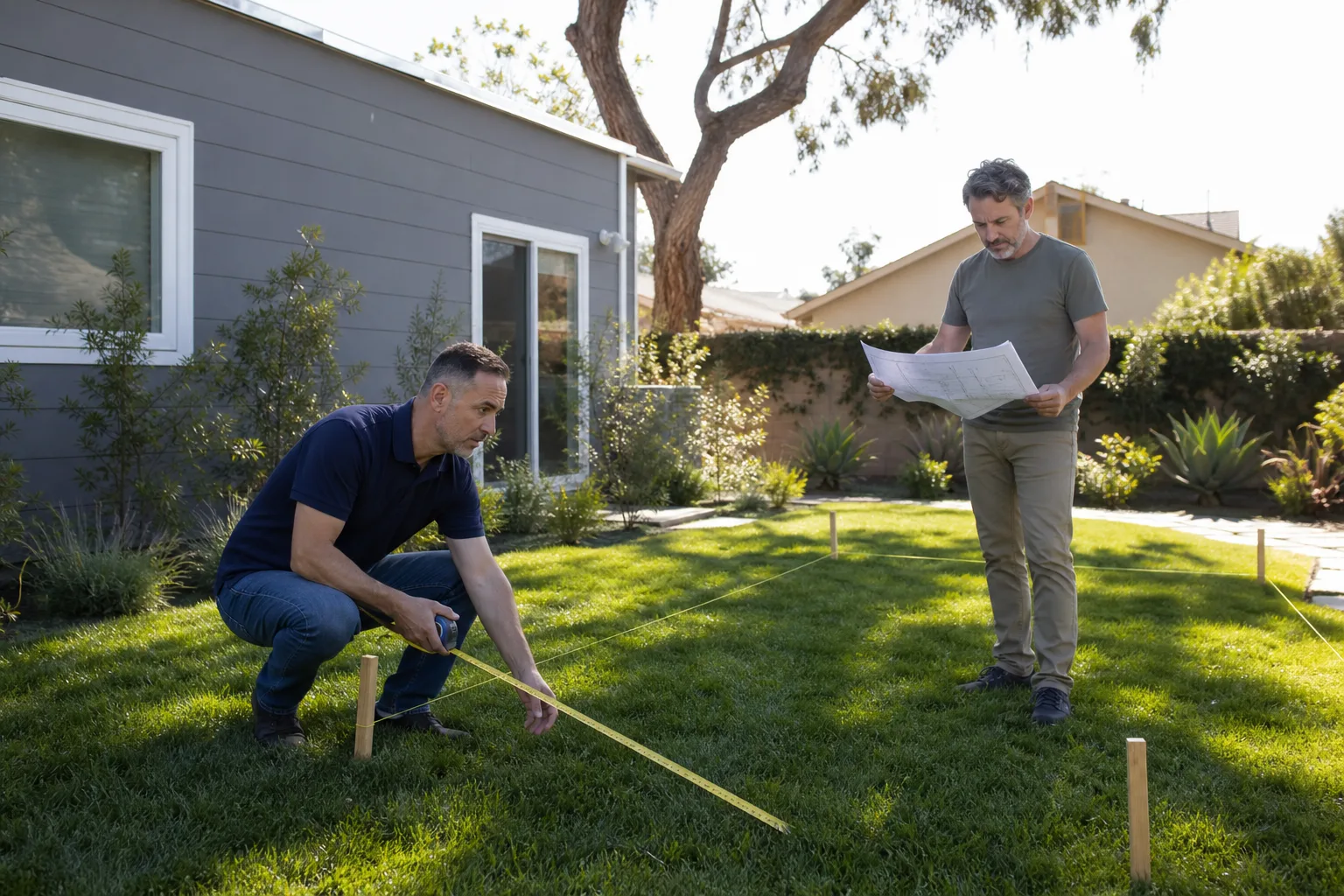
And then there’s the question of how the ADU connects to the main house. In Spring Valley, you’re often tying into existing utility runs on a lot that’s already built out. That’s where a site visit and a real soil check earn their keep. If the bid was written without anyone walking the lot, the bid was written for a different lot.
For broader context on what’s possible, see our ADU Builders in Spring Valley page, or if you’re thinking about square footage beyond a standalone ADU, our home addition contractor in Spring Valley and room addition contractor in Spring Valley pages cover bump-out and attached options that sometimes make more sense than a detached unit.
Common Mistakes to Avoid
- Signing before the license check. It’s four minutes on the Nevada State Contractors Board site. Doing it after you’ve signed is doing it too late.
- Comparing low bids against complete ones. In Spring Valley, the “20% cheaper” bid is often just a shorter scope. Print the bids side by side with line items and the gaps show up fast.
- Taking “we handle permits” verbally. Get it in writing with the contractor as applicant of record and the fees itemized. Verbal permit promises are the number one source of post-signing surprise costs.
- Accepting calendar-based payments. Tying draws to inspection milestones is one of the single biggest protections you have as a homeowner. Insist on it.
- Trusting a brand logo over a brand phone call. Anyone can list Dvele or Boxabl on their site. Ask for the dealer number and verify it. The real partnership will survive the call, the fake one won’t.
- Letting change orders happen without a signature. If the contract doesn’t cap what can be billed without your written approval, the cap is whatever the contractor says it is at month three.
- Skipping a site visit before bid. A bid written without anyone walking the lot in Spring Valley is a bid written for a lot that doesn’t exist. Insist that a real site visit happens before a real number is provided.
When to Call a Professional
If any of the following is true, it’s time to talk to a contractor who puts the plan and the price in writing before the first shovel turns: you’ve been quoted a number with no line-item breakdown; a contractor has told you permits will be “sorted out later”; the bid you like most is dramatically below the others with no explanation; a proposal lists prefab brand names without a verification path; or you simply want a real, written number for what an ADU will cost on your specific Spring Valley lot. Those are the moments where the process matters most, and where an honest conversation saves you real money. Benson ADU Builders Spring Valley offers free estimates in Spring Valley, and a written price before any work starts, every time. Call (833) 734-5583 to schedule yours.
Frequently Asked Questions
Search the contractor’s license number on the Nevada State Contractors Board website and confirm the status reads Active, the classification covers residential work, and the complaint history doesn’t show a recent pattern. Do this before you sign anything, and ask the contractor for their license number up front. A legitimate builder will give it to you without a second thought.
Because the missing cost doesn’t vanish, it gets billed later or cut from the build. When a bid comes in 20% or more below the others, the usual reason is a scope with holes in it: site work, utility tie-ins, permit fees, finishes, and contingency that weren’t written in. Always compare line items, not bottom lines. If you want to see what a complete written scope looks like for your Spring Valley lot, call (833) 734-5583 for a free estimate.
A lien waiver schedule, a change-order approval threshold requiring your written signature, and payment tied to inspection milestones rather than calendar dates are the three that do the most work. Add a written completion date with a defined remedy and a clear warranty. If your contract doesn’t have all five, ask why before you sign. Written guarantees are a baseline, not a bonus.
The contractor named as applicant of record, itemized permit and plan review fees in the bid, and a written process for handling plan review corrections including who pays for any engineering revisions. If it’s only said out loud, it isn’t a service, it’s a handshake. The full permit scope should be in your contract before any work starts.
Ask for the dealer number or the name of the brand’s representative, then call the brand directly to verify. Prefab ADU brands maintain authorized channel lists, and a two-minute call settles it. A contractor who can’t produce a verification path is a contractor whose “partnership” is a logo on a page.
Yes, and in some ways prefab handles our summers better than site-built, because the insulation and thermal specs are engineered in the factory rather than value-engineered in the field. The key is that the model you choose is specified for our climate: right-sized cooling, Hardie cladding or equivalent exterior, and insulation above the local minimum. Ask for the thermal spec sheet before you commit. Call (833) 734-5583 for a free estimate and we’ll walk through what works on your lot.
The Bottom Line

The warning signs that actually cost Spring Valley homeowners money aren’t the obvious ones you see in contractor-busting articles. They’re the polished proposal with no line-item scope. The “we pull permits later” handshake. The 20%-cheaper bid that quietly omits site work. The brand logo that was never a real partnership. The contract with calendar-based payments and no lien waiver schedule. Every one of those is fixable before you sign and expensive after. Written price, written scope, written timeline, written guarantee, verified license, verified brand partnership. That’s the whole checklist, and it fits on one page. Verify it before the first shovel, and you’re already ahead of the homeowner who didn’t.
Call (833) 734-5583 for a free estimate. We’ll put the price and the plan in writing before anything starts, and every project comes with our 365-Day Done Right Promise.
Written by the team at Benson ADU Builders Spring Valley.