Last updated November 18, 2026
The Complete Guide to ADU in Spring Valley
Most ADU guides on the first page of Google were written for Los Angeles homeowners. Spring Valley sits in unincorporated Clark County, which means different setback rules, a different permit desk, and different utility hookup fees – none of which those guides mention. If you’ve been reading about California’s ADU laws and wondering why the numbers and rules don’t line up with what you’re hearing locally, that’s why. This guide treats Spring Valley as the specific jurisdiction it is: a distinct unincorporated community inside Clark County, with its own approval path, its own realistic cost ranges, and its own set of obstacles (like older HOA rules) that catch homeowners off guard. By the end, you’ll know which ADU type fits your lot, what an all-in build actually costs in Spring Valley, and the exact steps from first phone call to certificate of occupancy.
Quick Answer
An ADU in Spring Valley, NV typically costs $120,000 to $280,000 all-in for 2025-2026, depending on whether you build a detached unit, an attached unit, or a converted interior space. Because Spring Valley is unincorporated Clark County, your permits run through Clark County’s building department rather than the City of Las Vegas, and Nevada SB 150 requires local jurisdictions to allow ADUs on lots zoned for single-family homes. Timelines run roughly 6 to 12 months for site-built and 4 to 7 months for prefab, with Clark County plan review being the biggest variable.
Table of Contents
- Why Spring Valley Being Unincorporated Clark County Changes Everything
- What Nevada SB 150 Unlocked: The Three ADU Types
- What Does an ADU Cost in Spring Valley?
- Prefab vs. Site-Built in the Nevada Desert Climate
- Which ADU Type Pencils Out on a Typical Spring Valley Lot?
- The HOA and CCR Conflict Risk Most Guides Ignore
- The Spring Valley ADU Permit Process, Step by Step
- How Spring Valley Homeowners Pay for an ADU
Why Spring Valley Being Unincorporated Clark County Changes Everything
Spring Valley is not part of the City of Las Vegas. It’s an unincorporated community inside Clark County, which means the rules that govern your ADU come from Clark County, not city hall downtown. That single fact changes the permit office you visit, the staff you’ll talk to, and in some cases the development standards that apply to your lot.
Here’s what that means in practice:
- Permit desk: You submit to Clark County’s building and fire departments, not City of Las Vegas permitting. Plans that pass city review aren’t automatically accepted at the county – they need to meet county code.
- Zoning: Most of Spring Valley’s residential parcels are zoned by Clark County as single-family (R-1 and similar), which is what triggers SB 150’s ADU allowance.
- Utilities: Water and sewer service in Spring Valley flows through the Clark County Water Reclamation District and the Las Vegas Valley Water District, not a city utility. ADU connection fees are set by those agencies, not by the city.
- Addressing and records: Your ADU gets a county address, not a city one. That matters for mail, emergency services, and rental listings.
We’ve seen homeowners waste weeks preparing a submittal package aimed at the wrong jurisdiction because a guide told them to “check with the city.” If you’re in Spring Valley, the city isn’t the authority – Clark County is. Getting that right on day one saves real time.
If you want a contractor who already knows the county process inside and out, our ADU Builders in Spring Valley page walks through how we handle submittals from the start.
What Nevada SB 150 Unlocked: The Three ADU Types
Nevada’s 2021 Senate Bill 150 is the law that made accessory dwelling units broadly legal on single-family lots across the state, including here in Spring Valley. It required local jurisdictions to allow ADUs on lots zoned for single-family homes and limited how far cities and counties could restrict them. Three ADU types are now realistic in Spring Valley:
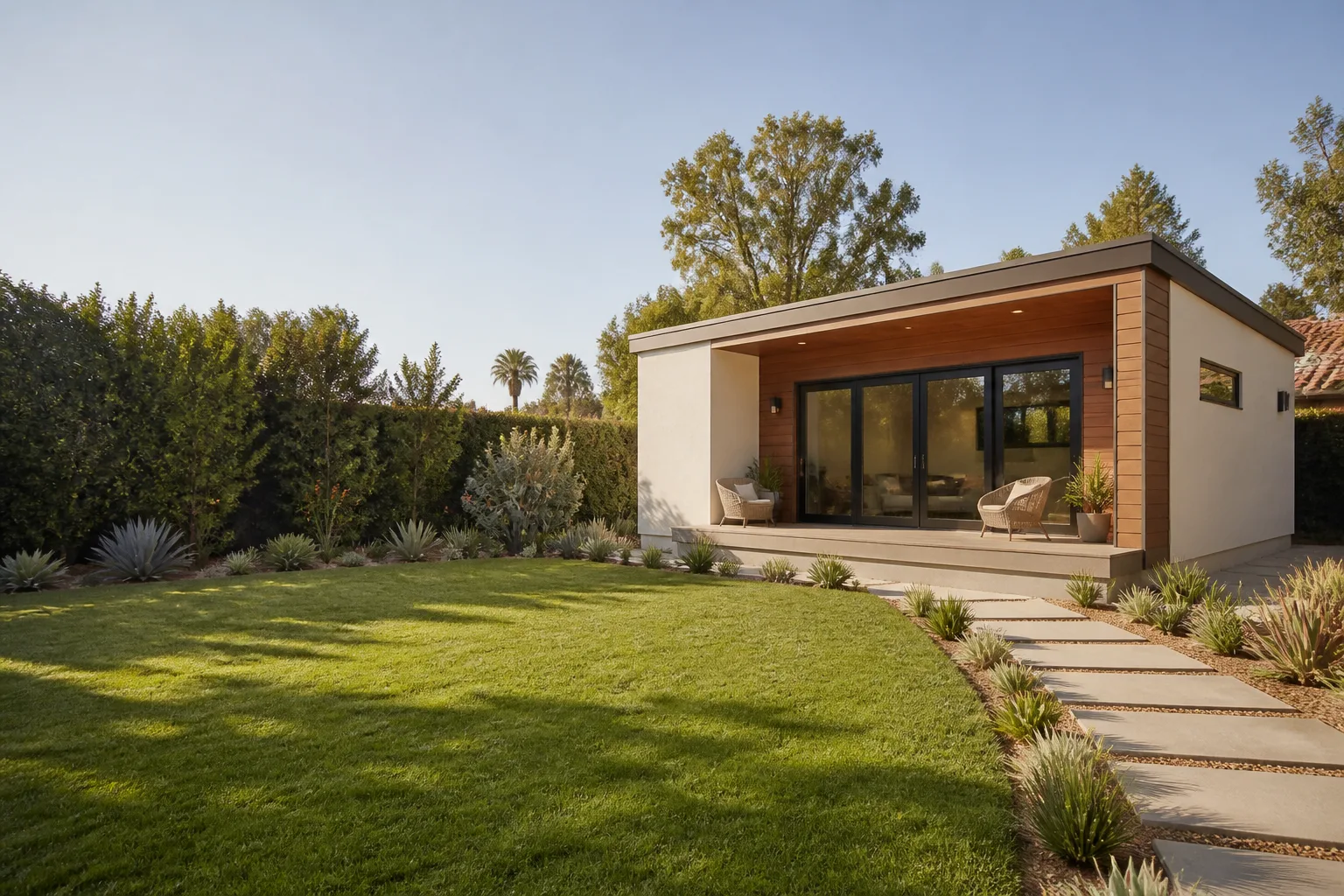
- Detached ADU: A freestanding structure in your backyard, fully separate from the main house. It offers the most privacy for tenants and family, and it’s often the biggest investment. Typical size: 600 to 1,000 square feet.
- Attached ADU: An addition to your existing home that has its own entrance, kitchen, and bathroom. It shares at least one wall with the main house. Often the best fit for narrow lots where a detached unit won’t clear setbacks.
- JADU (Junior ADU): A conversion of existing interior space (a garage, a bonus room, a portion of the main home) into a smaller unit, usually under 500 square feet. The lowest-cost option and the fastest to permit, but it shares some infrastructure with the main house.
Some jurisdictions also permit conversions of attached garages into full ADUs. Clark County’s rules govern which of these apply to your specific parcel, so the first real step is confirming what your zoning allows.
What Does an ADU Cost in Spring Valley?
An ADU in Spring Valley costs between $120,000 and $280,000 all-in for 2025-2026. Here’s how that breaks down by type and line item, so you can budget against your own numbers instead of a vague estimate.
All-in cost by ADU type
- JADU (interior conversion): $120,000 – $160,000. Smallest footprint, fastest permit, but you lose the interior space you convert.
- Attached ADU: $160,000 – $230,000. Shares a wall with the main house; plumbing and electrical tie into existing systems.
- Detached ADU (prefab): $180,000 – $250,000. Factory-built core panels assembled on-site, often lower labor hours.
- Detached ADU (site-built): $200,000 – $280,000. Stick-built on your lot; maximum design flexibility, longest timeline.
Line-item cost ranges
- Clark County permits and impact fees: $4,000 – $9,000 (varies with square footage and utility connections)
- Site work and utility trenching: $8,000 – $18,000 (higher on sloped lots or where the sewer line runs long)
- Foundation or slab: $12,000 – $22,000
- Prefab unit package: $90,000 – $170,000 for a 600-1,000 sq ft unit, depending on finish level
- Site-built shell and finishes: $130,000 – $200,000 for the same size range
- Utility hookups (water, sewer, electrical): $6,000 – $15,000
- Landscaping and final grading: $3,000 – $8,000
Those ranges reflect what we see across Spring Valley builds in the current market. Lot conditions, finish level, and whether you already have a spare sewer tap can swing the total by $30,000 or more. Every quote we produce is written down before work begins – no surprise invoices when the electrical inspector shows up.
If you’re also weighing an addition to the main house instead of a standalone unit, our Home Addition Contractor in Spring Valley page covers the cost ranges for that path.
Prefab vs. Site-Built in the Nevada Desert Climate
Spring Valley’s climate – specifically summer heat and monsoon-season rain – affects both build types, but for different reasons. Knowing how each handles the desert is the difference between an on-time project and months of stalled work.
Prefab ADUs (built as factory panels, then assembled on your lot) win on heat because the bulk of construction doesn’t happen in your backyard. The factory sets the panels, the crews assemble them over a few weeks, and you avoid the long cures and weather windows. We work with brands like Plant Prefab and Mighty Buildings, both of which build components that ship to the site ready to assemble. Timeline advantage: 4 to 7 months from contract to certificate of occupancy.
Site-built ADUs (framed, poured, and finished on your parcel) have to work with Southern Nevada’s heat – specifically, concrete curing. Concrete doesn’t cure in the technical sense; it sets and gains strength through a chemical reaction that runs too fast when temperatures are above 90°F. Summer pours in Spring Valley often need to happen early morning, and with evaporation-control measures, or the slab will crack before it ever carries load. That’s not a reason to avoid site-built; it’s a reason to schedule differently. Plan for framing and slab work in spring or fall where possible. Site-built timelines run 6 to 12 months.
Monsoon season (roughly July through September) affects both types. Roof installation, trenching, and exterior finishes can lose days when storms roll through the valley. Reputable builders build weather-days into the schedule, not into your invoice.
Which ADU Type Pencils Out on a Typical Spring Valley Lot?
Most Spring Valley single-family lots run between 6,000 and 9,000 square feet, and that size sets which ADU type is realistic once you clear the setback requirements Clark County applies.
Here’s the practical math. If your lot is 6,000 square feet with a 2,000-square-foot house placed toward the front, you probably have room for a JADU or a smaller attached ADU – not a detached 800-square-foot unit that needs its own footprint plus rear and side setbacks. On a 9,000-square-foot lot with a wide backyard, a detached ADU often works. Lots with alley access or corner positioning can sometimes fit a detached unit behind the main home.
Practical guidance on which type pencils out:
- Tight lot (under 7,000 sq ft): JADU or attached ADU. Highest ROI relative to total cost, fastest permit.
- Standard lot (7,000 – 8,500 sq ft): Attached ADU or smaller detached unit (600-700 sq ft). Good balance of privacy and cost.
- Generous lot (8,500+ sq ft): Detached prefab ADU in the 800-1,000 sq ft range. Best rental income potential.
- Corner or alley-access lot: Detached ADU offset toward the rear, separate entrance from the street.
Setback rules – the minimum distance from your ADU to your property line – are set by Clark County zoning. They vary between the front, side, and rear, and they’re one of the first things our team verifies for you.
The HOA and CCR Conflict Risk Most Guides Ignore
Many Spring Valley neighborhoods were built in the 1990s and 2000s with CC&Rs (Covenants, Conditions, and Restrictions) that predate SB 150 and can restrict what you build on your own lot. Some of those documents explicitly limit second structures, regulate outbuilding size, or prohibit additional dwelling units entirely. Nevada law has moved toward expanding ADU rights, but if your HOA rules conflict with what you’re planning, you can spend $8,000 on design work before the conflict surfaces.
Here’s how to protect yourself:
- Get the CC&Rs before you design. Request them from your HOA or county records. Read the sections on outbuildings, secondary structures, and architectural review.
- Submit an architectural review application to your HOA with the ADU plans before you file with the county. Many HOAs require this step regardless of state law.
- Ask for any ADU or second-structure prohibition in writing. If the board claims restrictions, get the section reference.
- Check the age of the CC&Rs. Documents recorded before Nevada’s ADU legislation may have provisions that are now void as against public policy – but you may need to work through the board or counsel to enforce that.
We flag this early in every Spring Valley project because it’s the single most common surprise in this market. If your HOA turns out to prohibit ADUs despite state law, you want to know in week one, not month four.
The Spring Valley ADU Permit Process, Step by Step
Here’s the process in order, from first call to certificate of occupancy. Clark County’s building department is your reviewing authority, and reviews run on their timeline, not ours – but here’s what to expect.
- Confirm your zoning and lot eligibility. Pull your parcel number and check the county’s zoning maps. Confirm your lot is zoned for single-family residential and that SB 150 applies.
- Check HOA and CC&Rs. Before design begins. See the section above.
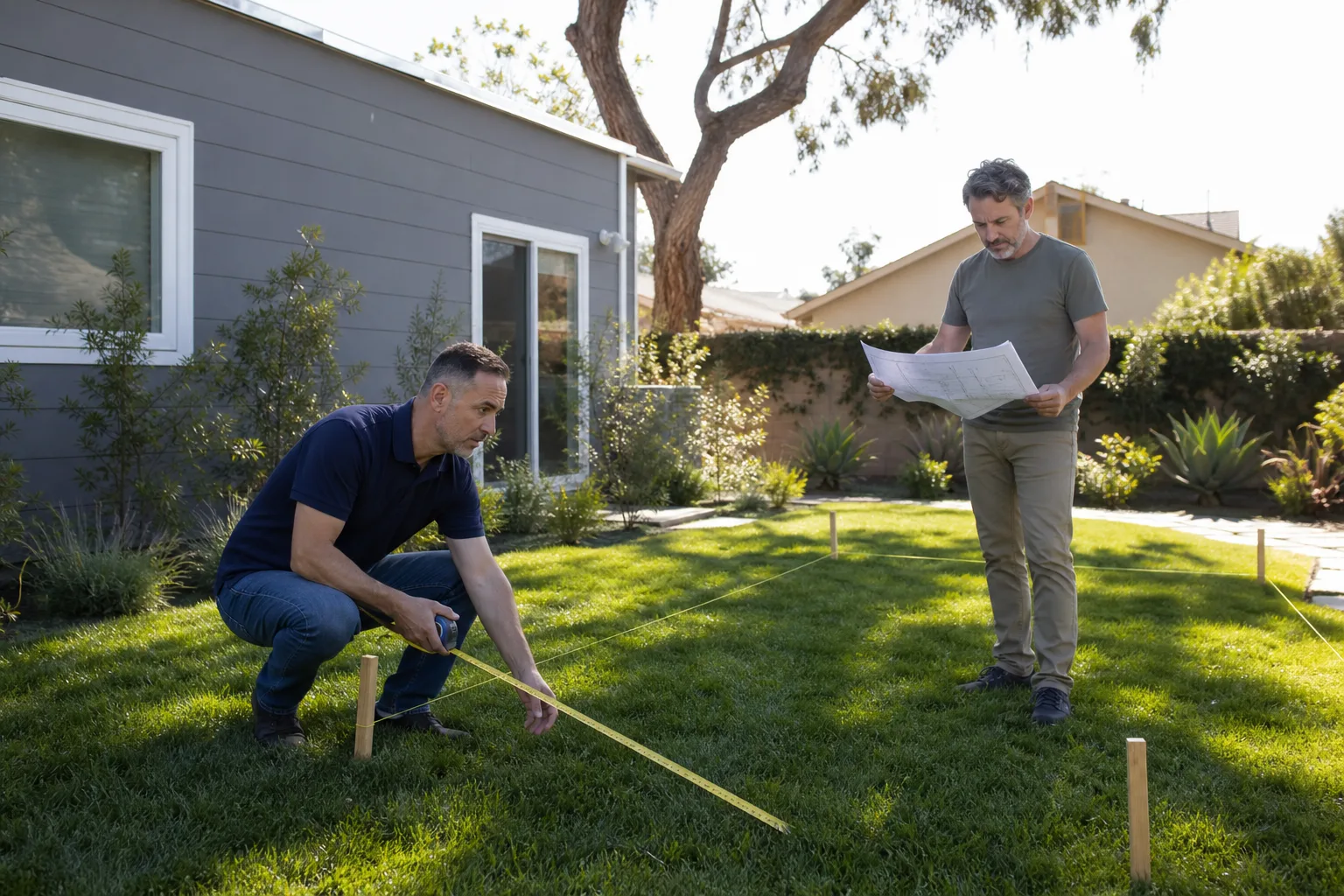
- Order a lot survey or site plan. Shows setbacks, existing structures, utility easements, and where your ADU can go.
- Design and engineering. Architectural drawings, structural engineering, and energy compliance (Title 24-equivalent). Prefab units come with factory engineering that gets adapted to your site.
- Submit plans to Clark County. Deliver the full package to the county building department. Plan review typically runs 4 to 8 weeks; complex submittals can stretch longer.
- Respond to plan-check comments. County reviewers will issue comments; your builder or designer addresses them and resubmits. This step is where most delays happen.
- Receive your building permit. Once approved, pull the permit and schedule inspections.
- Construction and inspections. Foundation, framing, electrical, plumbing, mechanical, and final inspection are all county-run. Expect four to six scheduled inspections on a typical ADU.
- Utility connections and certificate of occupancy. Water, sewer, and electrical connect to the county-served systems; the CO is issued after final inspection passes.
When the process is done, your ADU is legally habitable, separately addressed, and ready for family or a renter – or, if you also want to enlarge the main home, that’s where a Room Addition Contractor in Spring Valley comes in on a parallel track.
How Spring Valley Homeowners Pay for an ADU
Most Spring Valley ADUs get funded through one of four routes, and each shapes the type of unit you can build. Cash or savings is fastest and cheapest; the other three carry tradeoffs.
- Cash or savings: Simplest and cheapest. No interest, no lender timeline, no appraisal risk. Only realistic if you already have the funds available.
- Home equity line of credit (HELOC): Borrow against your existing equity. Works well for $120K-$200K ADUs where your home value supports a meaningful draw. Variable rates.
- Cash-out refinance: Roll your existing mortgage into a larger loan and take cash out for the ADU. Fixed rates, but you’re refinancing your whole mortgage.
- ADU-specific construction loans: Some lenders offer loans built for ADU projects specifically. They may close faster than a full cash-out but often carry higher rates.
Rental economics are the reason most Spring Valley homeowners do this. A detached 800-square-foot ADU in the current Spring Valley rental market supports meaningful monthly rent, and existing homes in established neighborhoods are often underutilized – big yards with plenty of buildable space. The math works when the ADU cost comes in under the value it adds to your property, which is generally the case for mid-sized detached and attached units on good lots.
Whichever route you choose, get a written estimate before you borrow. Lenders want a number, not a “probably around” – and the number should be locked before you sign.
Common Mistakes to Avoid
- Using a California ADU guide as your playbook. California’s ADU laws, fees, and timelines differ from Nevada’s, and Las Vegas-area rules run through Clark County, not Sacramento. Reading a California guide gets you confidently wrong.
- Designing before checking HOA rules. We’ve seen homeowners spend real money on plans before learning their CC&Rs prohibit second structures. Check first.
- Not confirming which permit office applies. Spring Valley is unincorporated Clark County, not City of Las Vegas. Submit to the wrong jurisdiction and your plans get bounced.
- Planning a concrete pour for the middle of summer without protection. July and August pours in Spring Valley crack if they cure too fast. Schedule around heat or protect the slab.
- Forgetting utility capacity. A detached ADU with its own kitchen and bathroom roughly doubles the water and sewer demand at your meter. Confirm capacity with the water district before you design.
- Accepting a verbal estimate. Verbal estimates drift. Written estimates with line items and change-order terms protect you and force the contractor to be honest on day one.
- Underestimating the plan review timeline. Clark County plan review is the biggest variable in the schedule. Budget 4-8 weeks in addition to construction.
When to Call a Professional
Some ADU decisions are straightforward and some aren’t. Call a professional if any of these apply: your lot is under 7,000 square feet and you’re trying to fit a detached unit; your HOA has older CC&Rs and you don’t know what they allow; you’re weighing prefab versus site-built and you’re not sure which fits your timeline; you need to confirm Clark County setbacks for your specific parcel; or you plan to fund the project with a loan and need a written estimate that satisfies a lender. A structural issue, utility capacity concern, or a plan-check comment you don’t fully understand are all reasons to get an expert on the phone.
Benson ADU Builders Spring Valley offers free estimates in Spring Valley – call (833) 734-5583. We put the number in writing before any work starts, and we’ll tell you in the first conversation whether your lot, your HOA, and your budget actually line up.
Frequently Asked Questions
An ADU in Spring Valley costs $120,000 to $280,000 all-in for 2025-2026, with JADUs at the low end and detached site-built units at the high end. Permits, site work, and finish level swing the total by $30,000 or more. Call (833) 734-5583 for an exact quote based on your lot – estimates are free.
Spring Valley is unincorporated Clark County, not part of the City of Las Vegas. That means your ADU permits, setbacks, and utility connections run through Clark County agencies, not city hall. Getting this wrong is one of the most common early mistakes we see.
Maybe – it depends on your community’s CC&Rs. Some Spring Valley HOAs have older restrictions on second structures that predate Nevada SB 150. Check your CC&Rs before you design anything, and file the architectural review with your HOA before submitting to the county.
A prefab ADU typically takes 4 to 7 months from contract to certificate of occupancy; a site-built ADU runs 6 to 12 months. Clark County plan review is the biggest variable, usually adding 4 to 8 weeks. Weather delays during monsoon season can push the schedule further.
If your lot is zoned for single-family residential and your HOA doesn’t prohibit it, Nevada SB 150 requires the county to allow it. Lots of 7,000 square feet or more usually fit a detached unit; smaller lots are better suited to a JADU or attached ADU.
Yes. Clark County requires a building permit for any ADU, whether prefab or site-built, and inspections run through the county. Skipping the permit means the unit isn’t legally habitable, which impacts insurance, lending, and rental income.
The Bottom Line
Building an ADU in Spring Valley isn’t the same project as building one in California, and it isn’t the same as building in the City of Las Vegas. It runs through Clark County, it works within local lot sizes and setbacks, and it carries specific costs in the $120K-$280K range for 2025-2026 depending on type. SB 150 opened three paths – detached, attached, and JADU – and each fits a different lot. Check your HOA before you design. Plan around the summer heat. Get a written estimate before you sign anything. Do those four things and the project stays on solid ground from day one.
You can also start with our Benson ADU Builders Spring Valley home page for an overview of how we build, and read through our ADU builders guide to Spring Valley before your first call.
Get a Free ADU Estimate in Spring Valley
Call (833) 734-5583 for a free estimate in Spring Valley. We’ll confirm your county zoning, review your HOA rules with you, walk your lot, and hand you a written price before any work begins – with our 365-Day Done Right Promise attached to every project. Whether you’re planning a prefab from Mighty Buildings or Plant Prefab, or a site-built ADU designed around your lot, our team will tell you honestly what fits, what it costs, and what your neighbors with similar lots have built.
Written by the team at Benson ADU Builders Spring Valley.